Chronicle No. 14 · History
The Last Galleried Inn: What London's Coaching Yards Were Really For
Chaucer's pilgrims set out from Southwark. Four hundred years later the railways swallowed the inns. One yard survived.
Southwark, on the south bank of the Thames, was where a journey out of London properly began. Travellers who missed the closing of London Bridge slept there. Pilgrims heading for Canterbury gathered there.
One of those inns was The Tabard, and it is where Geoffrey Chaucer set the opening of The Canterbury Tales. His narrator's verdict on the place is the earliest great English hotel review: the chambers and the stables were wide, and we were eased at the very best.
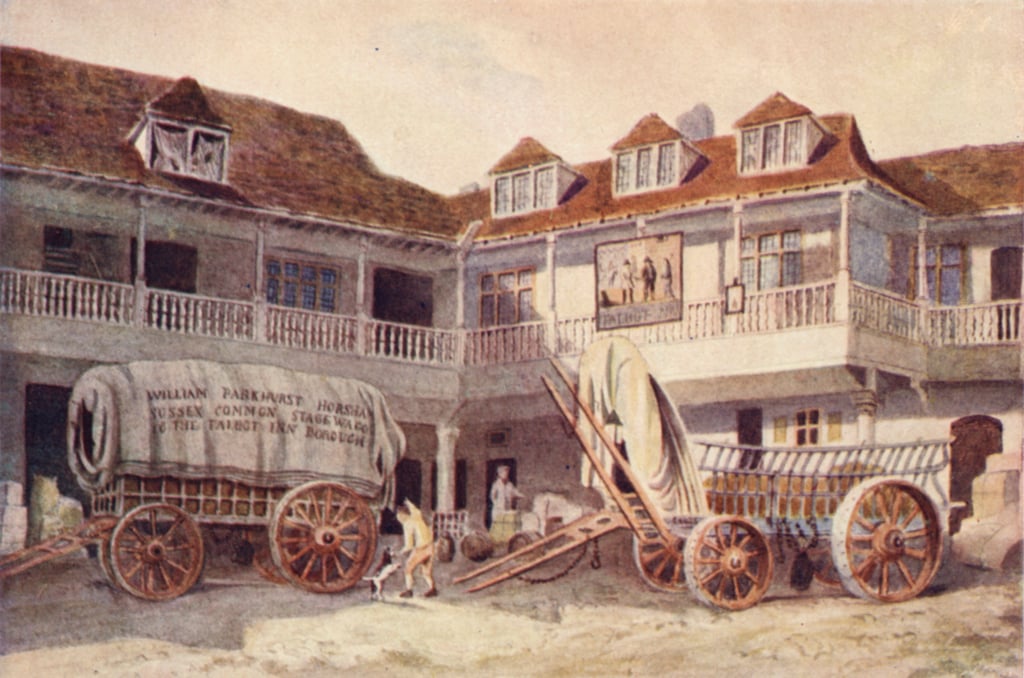
Southwark's inns shared a shape. Rooms ran around a courtyard on open galleries, with stables below, so that a coach could pull straight in off the high street and passengers could reach their doors without crossing anyone else's room. It was efficient and it was sociable; Shakespeare's plays have long been performed in such yards.
Immediately to the north of the Tabard stood The George. An inn is recorded on the site by 1542 and probably earlier. It burned in the Great Fire of Southwark in 1676 and was rebuilt the following year around three sides of its courtyard. Charles Dickens drank in its coffee room and put it into Little Dorrit.
Then came the railway. The Great Northern Railway took the George as a goods depot and pulled down two of its three ranges for warehousing. Only the south face is left. The Tabard fared worse and was demolished in 1873.
The George passed to the National Trust in 1937 and is Grade I listed. It still serves beer in a galleried yard, the only one of its kind left in London.
Inns die when the traffic they were built for stops arriving. What saves a building is being loved for something other than its original function.
“The chambres and the stables weren wyde, and wel we weren esed atte beste”
Lesson: When the way people travel changes, the inns that only served the old journey disappear; the ones that mean something to the neighbourhood survive.